With everyone drowning in their phones, people can easily be fed misinformation. Crises around the world, such as the Gaza-Israel conflict, can be easily skewed to fit a certain narrative.
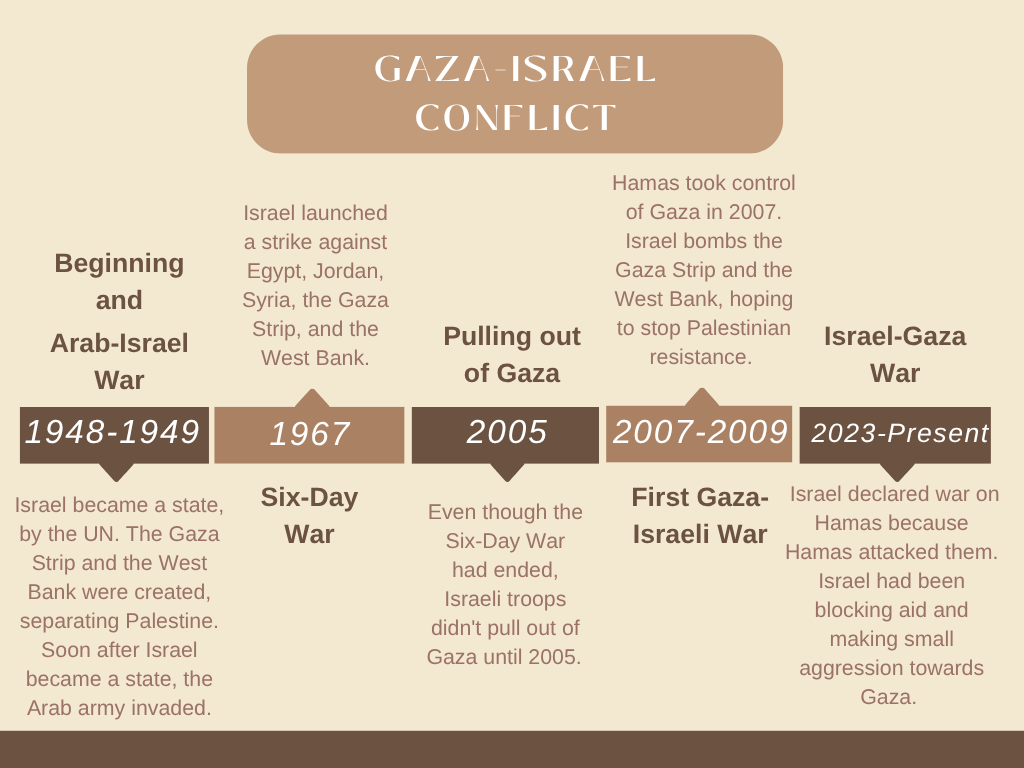
Starting in October 2023, Israel declared war against Hamas. This conflict has lasted two years and is still ongoing. On October 10, 2025, the Trump Administration proposed a ceasefire for Hamas and Israel to stop the conflict and hand over hostages from both sides.
With teens, many don’t know what to think of the Gaza-Israel war. Wars can be started for many different reasons, but some are unsure whether this is really a war. Senior Ela Kays explains her thoughts on the conflict.
”I think this is a genocide, and [a] cleansing…Israel feels like they have some sort of God given right to take over the land of Palestine,” Kays said. “[Palestine doesn’t] have the resources or anything to fight back. So I feel like it’s not really a war. They’re using religion as a reason to try to expand. They found the closest minority that can’t fight back.”
With the amount of media consumed by the average American daily, it’s easy to be misinformed and fall into the depths of the internet. Many people judge based on limited information and cropped videos.
“I feel like people keep circling back to [Hamas] as a rising justification,” Kays said. “Hamas organized a terrorist attack on Israel, but started it all. But I feel like a small terrorist attack is not at all equivalent to a full-on genocide.”
Other students express their concerns for the ongoing war and ceasefire between Israel and Hamas.
“We [have] got to understand why they’re fighting. Hamas went to Israel and murdered 100 civilians. …in response, Israel has been trying to find these Hamas fighters,” senior Samuel Siegel said. “And with that, a lot of civilians in Gaza died because of that.”
Some, like Siegel, believe this is a war between Hamas and Israel, instead of a genocide.
“If they really wanted to kill [Palestine’s] whole population, they could; it would not take them two years to do it,” Siegel said, “If it were a true genocide, they would have blown up Gaza by now.”
NAHS students are also watching how our own country handles this major crisis.
“I think it’s bound to break eventually,” Siegel said. “So I’m not sure how any president, not just our president now, would handle that.”
NAHS. Some students believe that the Gaza conflict won’t affect them, but as connected as teenagers are globally, it could affect them and their future. Most watch in real time how the US’s own administration handles this ceasefire, as well as the live events happening in front of their eyes.
US. The Trump administration, the one that negotiated the October 10 ceasefire, has been tightening on Hamas. Claiming that if Hamas steps out of line, they will be ‘eradicated’. Vice President Vance has made frequent visits to Israel, repeating Trump’s words, while Israel seems immune to the Trump Administration’s scrutiny. The administration is only putting one side at fault.
That has changed. Earlier this week, Israel was thinking about annexing the West Bank. The Trump Administration, in return, threatened to cut funding and ties with Israel, only if Israel annexed the West Bank. The US, just in the past two years, has sent over $21.7 billion in aid to Israel, in total, a whopping $300 billion over the past 77 years, according to the Quincy Institution for Responsible Statecraft.
Misinformation. Length: Altogether, this consistent conflict has lasted a total of three years and two months, not including the violence between each war, which lasted for 78 years.
War versus genocide: According to the Guardian and The International Association of Genocide Scholars, a globally recognized group founded in 1994, “Israel’s policies and actions in Gaza meet the legal definition of genocide,” according to the group’s resolution, which was supported by 86% of those who voted, which Israel has denied the accusations.
What’s actually happening. Following the October 10 ceasefire, Israel and Hamas both agreed to return hostages. Shortly after, Israel sent an airstrike to Rafah, killing at least 44 Palestinians according to the Gaza Hospital. Israel claims that Hamas killed two IDF soldiers; Hamas denied the accusations. This sent aid and resources to a halt.
When the UN Aid Chief, Tom Fletcher, visited Gaza after the attack, he famously commented on how it was a ‘wasteland’. Allowing the UN to step in and provide aid by clearing roads, providing food, and more, for a while until the ban. Meanwhile, Hamas has made countless claims, condemning Israel’s failure to reopen the Rafah crossing between Gaza and Egypt. Blocking injured and sick Palestinians from getting proper medical care, as well as deliveries and humanitarian aid.
In the West Bank, illegal Israeli settlers have been attacking Palestinians, stealing livestock and food, and aiding local farms and Palestinian settlements. Violence escalates as they burn trees and cause harm to Palestinians, 13 total injured.
As violence continues to grow, on October 28, Israeli Prime Minister Benjamin Netanyahu ordered powerful strikes on the Gaza Strip. Accusing Hamas of breaking the ceasefire. Earlier that day, there was firing down at Rafah; Israelis believe it to be Hamas or a Palestinian activist. In response, Israel bombed Gaza. In total, Israel has breached the ceasefire 47 times and has killed about 44 Palestinians in the past 19 days, with numbers still rising.
On October 29, Israel bombed Gaza again, killing over 100 Palestinians. They have also detained six journalists in the West Bank. Over 200 media personnel have died in the past two years, and major Middle Eastern newspapers are banned from Israel. Along with this prolonged escalation of violence, Israel stormed into the West Bank, raiding the villages of Qabatiya and Anza. Israel has also banned the Red Cross from visiting Palestinian prisoners, according to the ICRC.
On October 30, Hamas agreed to hand over the remaining bodies to Israel. Via the Red Cross, the remaining bodies have been given to Israel, but in Gaza, people are still missing. Lebanon’s President, Joseph Aoun, has announced that the army will go and confront Israel after the attacks on Gaza. The French foreign minister has also made plans to station in Israel. The US and France are both pushing the UN for a decision on the International Stabilisation Force in Gaza.
Israel still occupies Gaza and the West Bank. While in Gaza, Israel demolishes houses and other property, paying contractors to do the work.
With the ceasefire and aid being blocked, Palestinians are running out of food and supplies, according to a UN survey. A campaign to vaccinate roughly 40,000 children under the age of three will begin next week, according to Gaza’s Health Ministry, which has said the move will target diseases such as measles, polio, and meningitis.
Israel has been slowly returning bodies and prisoners, bringing a total of 270 bodies returned to loved ones. Leaked videos have been circulating of Palestinian abuse. Former IDF Major General Yifat Tomer-Yerushalmi took full account of the video and was arrested for the crime. Israel has also imposed a new bill, stating that the death penalty is mandatory for anyone convicted of terrorism. The bill must pass three plenary votes in the Knesset, the Israeli legislature, to become law.