The New Year holiday is usually a time spent with family and friends at home or out having fun. For Venezuela’s president, Nicolás Maduro, the holiday brought his removal from the country.
The history behind Maduro’s presidency
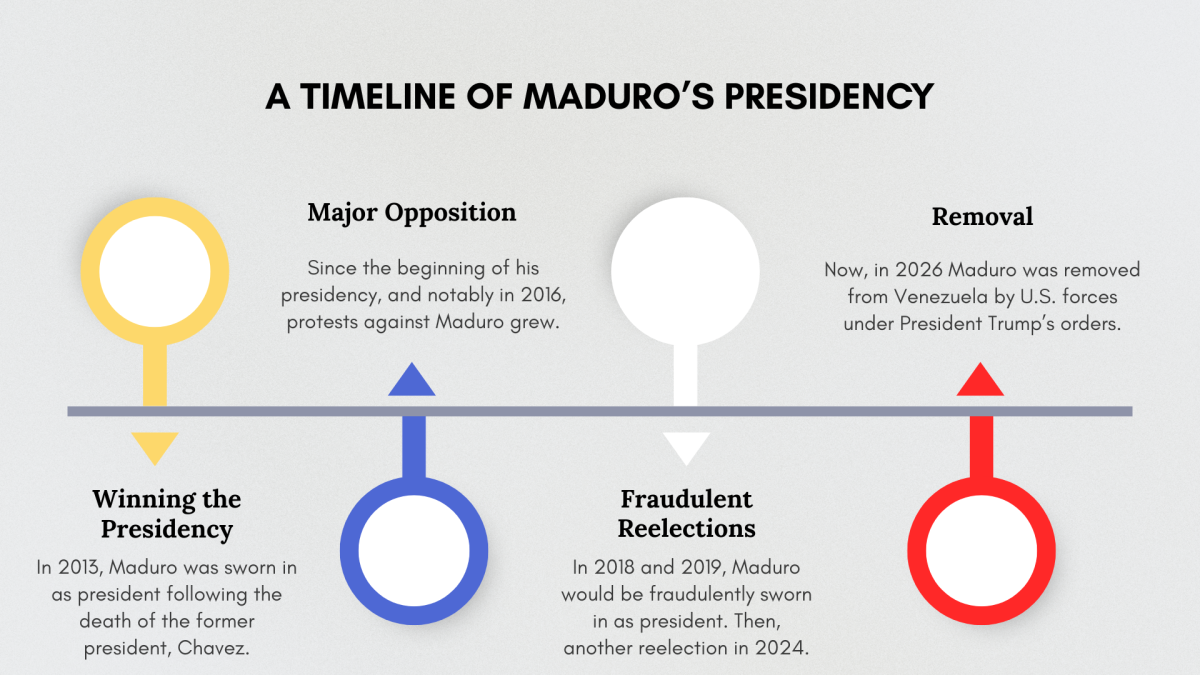
In 2013, following the death of, at the time, Venezuelan President Hugo Chávez, a special election was held for who would take up the role as president. There was only a small margin of a difference between the two leading candidates in the end, resulting in Maduro’s first presidential term. Since the start of his time as president, Maduro faced backlash; his opponent in the election, Henrique Capriles, demanded a recount. Capriles and his supporters suspected that the voting had been manipulated and urged that they recount every single vote, though this recount was never granted, according to Fortune.
After his term finished and election day came around again, Maduro had no plans of leaving office. 2019 saw Maduro’s illegally achieved second term as president through a rigged election. Outrage spread through Venezuela – what was discontent became validated concerns and people believed this was only a start to how far Maduro could and would go, according to US Department of State.
Maduro, just like Chávez, saw the U.S. as the biggest threat to Venezuela’s government. Maduro continued Chávez’s action in making sure Democratic and Republican administrations would never find their way into the government. Rather, he further led Venezuela into what the world would call a Socialist nation, according to The Guardian. It was becoming more and more obvious that Maduro would mold Venezuela how he wanted no matter who objected.
His administration imprisoned politicians and any leaders who were distributing food, according to US Department of State. The economy he inherited from Chávez was already on the brink of collapse but only worsened under him, according to NPR. His presidency has seen the migration of over millions of Venezuelans looking for a better life elsewhere. His administration would become what can only be described as a dictatorship for those in free countries.
Trump vs. Maduro
President Trump, since his second term in January of 2025, has been very active in conversations regarding U.S. interventions in other countries. While Venezuela is the country where the president has intervened most drastically, he has also spoken of, or has already proceeded with, interventions in Nigeria, Somalia, Iraq and other Middle Eastern countries, Colombia, Cuba, Mexico, and has most recently set his sights on Greenland, according to Council on Foreign Relations. Countries like Iran and Mexico have made their ideas of his intervention vocal, with Iran issuing a threat against President Trump’s life, and Mexico’s President giving her clear disapproval of his ideas.
What started as strikes against alleged vessels smuggling drugs along the Pacific and Caribbean became threats against the Venezuelan government. Then, on January 3, 2026, Maduro, along with his wife, Cilia Flores, was captured by the U.S. administration, according to CNN.
The Trump administration stated that they were taking Maduro and his wife to the U.S. to face criminal charges in New York. The two would be facing charges for being involved in a narco-terrorism conspiracy, while experts debated and doubted the administration’s actions had been legal, according to PBS. On January 5 Maduro and Flores made their first appearance in court, in Manhattan. There, they both pleaded not guilty to the charges they were facing.
The question of what would happen to Venezuela without Maduro began receiving mixed answers. While the Trump administration claimed that the U.S. would handle Venezuela, Maduro’s vice president, Delcy Rodriguez, insisted that Maduro still be referred to as the nation’s true leader, according to PBS.
Varying opinions
Given that Venezuela has the highest oil reserves, the Trump administration has made their intentions of taking over business surrounding Venezuela’s oil clear. Secretary of State Marco Rubio had announced the administration’s three-phase plan following the removal of Maduro, according to Carnegie. This plan claims to ensure that the U.S. would oversee the reserves and benefit the Venezuelan population with the proceeds rather than corporate or corrupt business. The talk surrounding what would happen in Venezuela receives many opinions. While some Venezuelan citizens believe that President Trump’s intervention was a necessary good, many believe the opposite.
Even outside of Venezuela, people in nearby countries have shared their stances online. A poll run by PBS showed that a majority of Americans did not think that President Trump was doing the right thing by intervening the way his administration did. On the other hand,
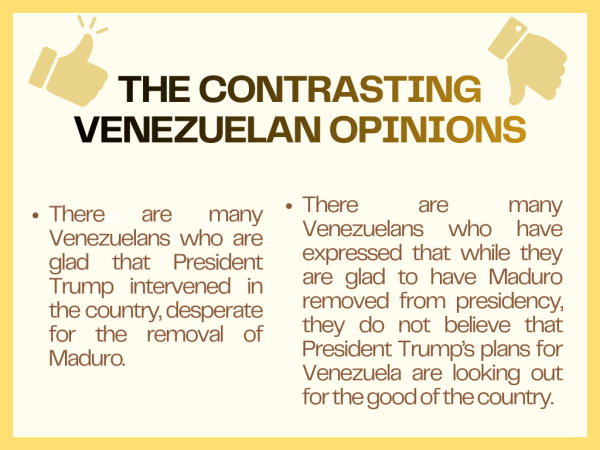 the poll shows that there are 44% of Americans who do support the actions the U.S. has taken on Venezuela.
While opinions continue to form and be shared online and in conversations, the government will be preparing for further actions. As Maduro’s legal case goes into its next steps, it’s been hinted that the U.S. will look into creating a government in Venezuela that can be described as being somewhat remotely controlled by the U.S., according to CSIS. With news updates flowing in regularly, the public can stay caught up through the media with what the government plans to do next.